100 days of Italian on Duolingo
I just got to a 100 day learning streak on Duolingo, something that I am quite proud of. It's one of the longest daily streaks I have done for... just about any challenge.
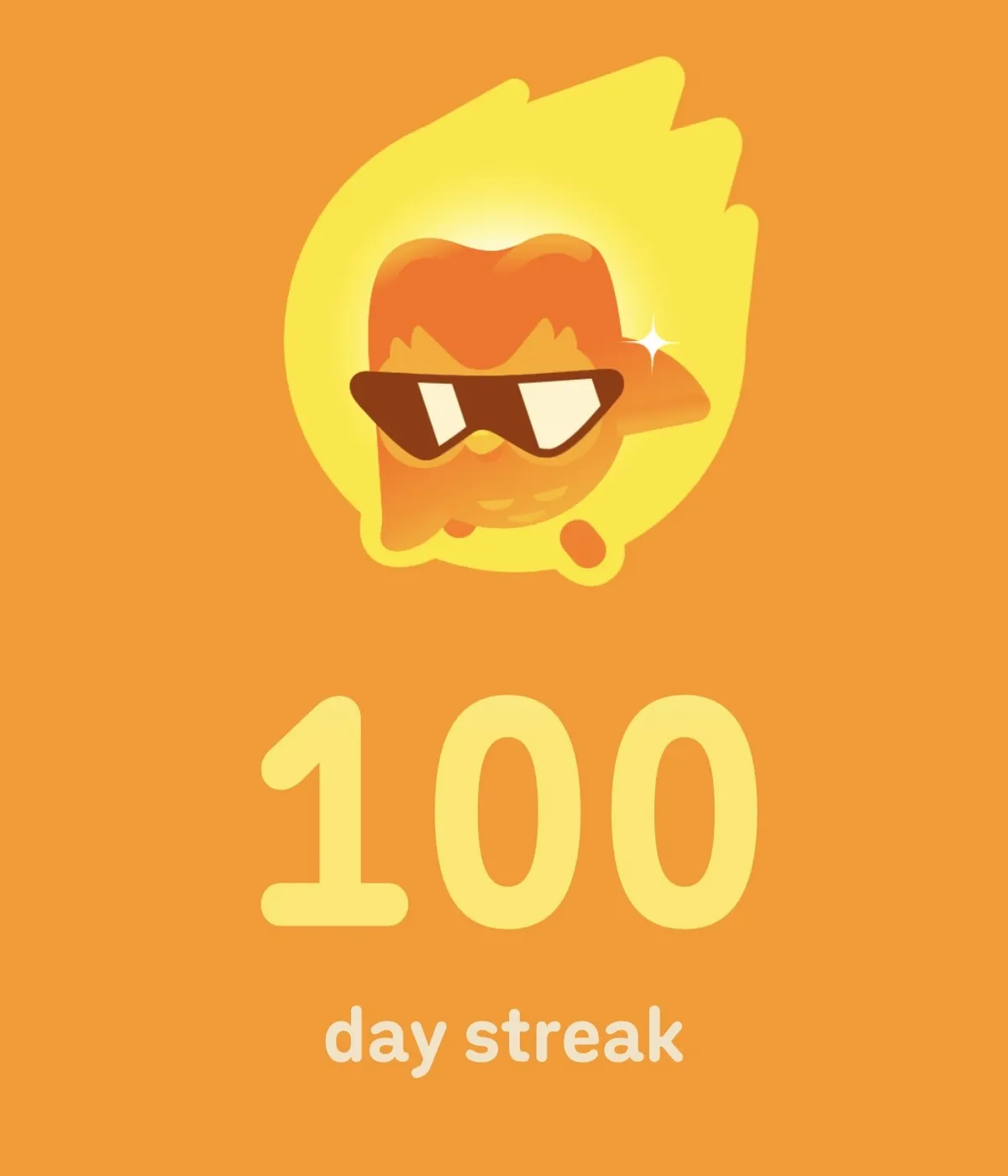
My duo looks cool and is on fire!
Most of these days I would spend 10-30 minutes doing lessons and activities. The lessons involve learning new words, making a sentence, describing a picture, reading a story, flashcards or talking to a character powered by AI. On some of the low effort and busy days, I try to do a lesson to get in my daily streak and to keep it as a habit.
After 100 days, a little over 3 months, I feel comfortable saying some basic things in Italian and greeting some of my older neighbors in Italian. I think they are surprised and impressed with what I've been doing, and they teach me new words and phrases from time to time. I am not talking to anyone with full and grammatically correct sentences yet, but the grandma next door is fairly enthusiastic on my current project. To me, it's a win because I find new things to talk about with my neighbors and experiencing a different culture.
Duolingo is a great way to get started, but there's tradeoffs because the app/program is focused on fun. After 3 months, I have noticed a lot of interesting features and strategies that Duolingo use to keep its users engaged. I hope I can write a couple of posts about it, and perhaps make it into a series. I am sure other people already write about this, but it's my blog so I do what I want :) I will talk about how Duolingo uses gamification, its social strategy to bring in and keep users, the streak system, the challenge and leaderboard system, as well as how it introduces novelty for users etc.
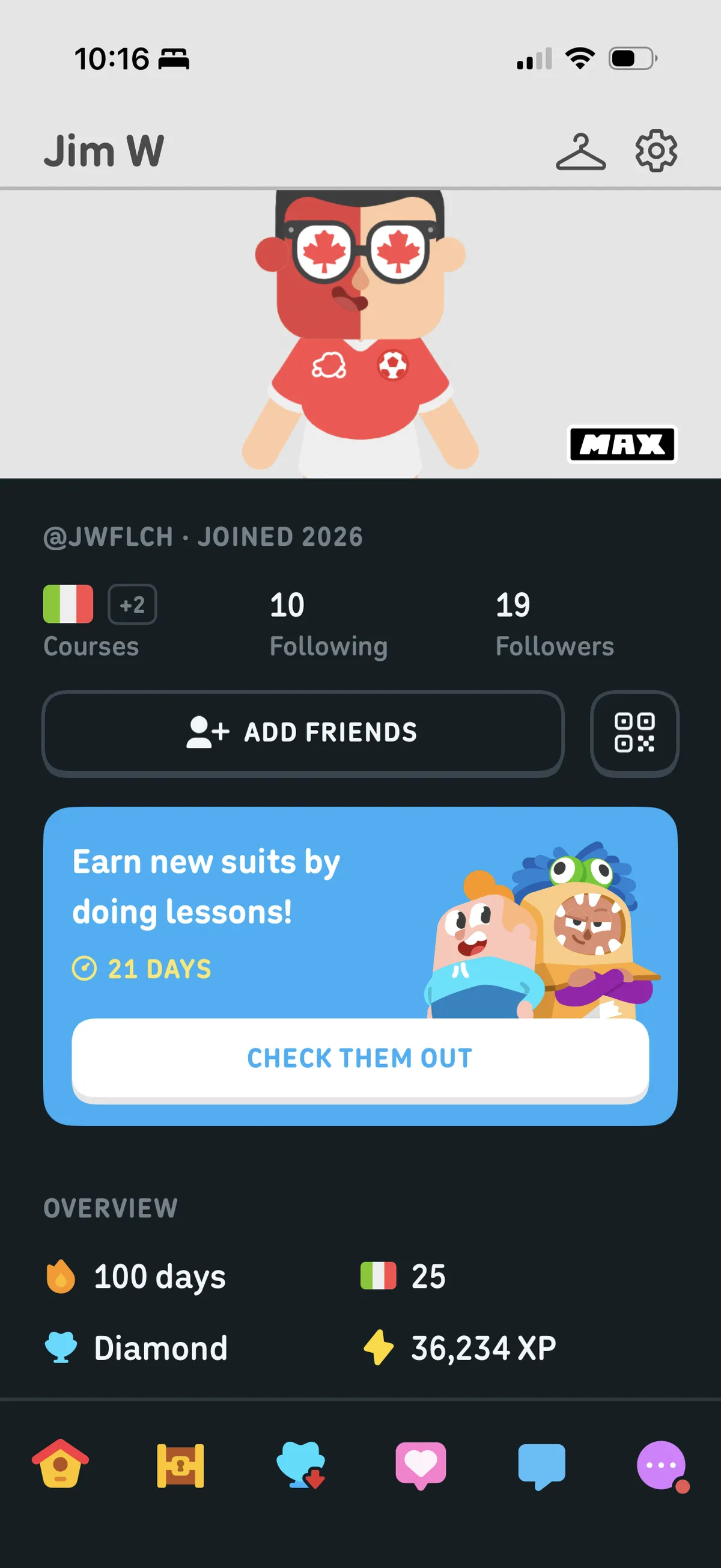
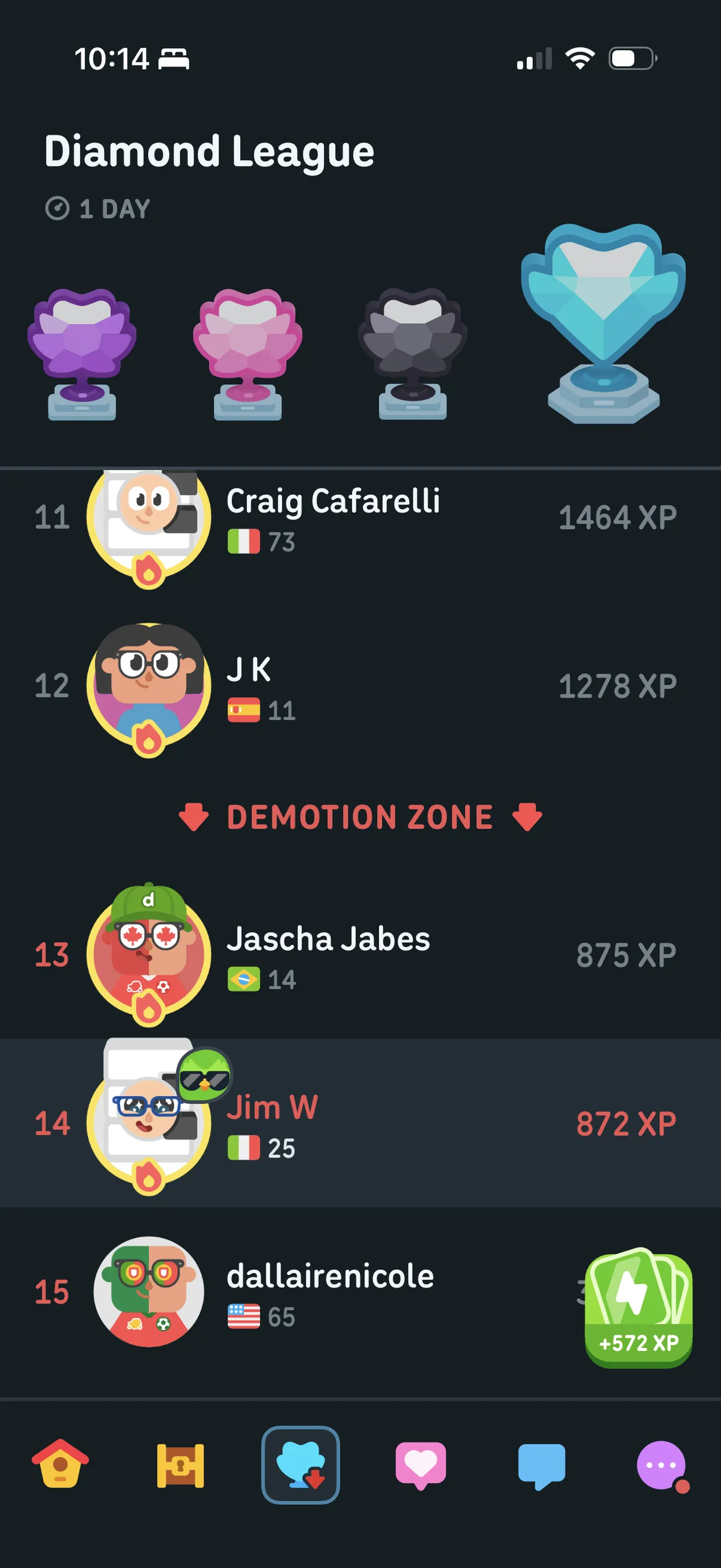
I am getting demoted in my ranking because I am not doing enough lessons!
For most langauge learners out there, I think it's the perfect tool to get started. The the app is vibrant, the mood is fun, and just enough competition and challenge to keep you hooked. But what happens, when you lose your motivation or learning gets difficult?
I hear stories about people who have 1000 day streaks, who can hardly say a thing or two in the language they learn. They struggle with carrying on a conversation and don't have confidence to talk to people. I know this feeling too well. Language learning is not always fun and sometimes you have to risk embarassment to improve. To really understand a new language, it involves studying grammar and understanding the logic in which the language is based on.
A brief example and lesson, consider the word "to eat" in Italian:
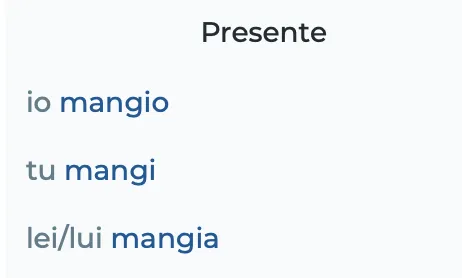
I still use reverso and online dictionaries to look things up.
There are different forms of the word "to eat", depending on the subject doing the action (I eat, you eat, he eats). This is known as conjugation and something done in all latin/romance languages. This is not something Duolingo emphasize on learning on the get go. Unlike in traditional classrooms where students do worksheets and assignments until we get them right.
Memorizing grammar, conjugation, gender of words, is not really fun. So far, in Duolingo level 25 Italian, we don't have a dedicated chapter to master these concepts, and you'd have to discover or look for it. Perhaps in later lessons or features this will be a thing, but so far I am not seeing a formal lesson except on hard to find tip section.
Additionally, I find the lessons to be linear and not adaptive. I suspect Duolingo has an opinion on what lessons will be the most useful for general users, instead of targetting them for users with specific interests (travelling specific, or daily conversation focused). They also copy this same formula and curriculum for other latin languages, like Spanish. I believe most language lessons starts with learning how to order coffee and move to saying what you study.
Hey, it's general app that appeals to the everyone and I get that. I just wonder if my neighbors will care about how many emails I send in a meeting (reunione), or "Confirm my arrival plans" when I see her on her walk.
There's also the issue of switching context. Certain words, or logical grouping of ideas (weather, feelings, how to ask questions) are not always grouped together. For example, you may learn to say the number 3, but the number 9 doesn't come until much later or in the chapter. I know for a fact I can't count to 20 yet after 100 days. I don't even know if I can even count up to 10 on an unlucky day, because we haven't studied numbers from the start and tell exact time - also not fun but essential.
Of course, no technology is perfect and no program can do everything. For some, simply logging in and finishing a lesson feels good enough and entertaining on its own. For the keen students, the onus and challenge is on them to find ways to fill the knowledge gap. In my opinion, that is also okay and should be encouraged. Duolingo is still my best bet, and I hope to continue all they way to level 30 (A2 - Elementary proficiency).
Just as I was writing, a new feature came out that you can use to fill gaps. My opinion may shift yet again!